


There was once a merchant so rich that he could have paved the whole street with gold and almost had enough for a little lane besides.
But he did not do that, for he knew the value of money and would never waste it in such a way.
He was a clever man, and every shilling he spent came back to him as a gold coin.
So he went on, acquiring wealth, until he died.
His son inherited all this money and lived very merrily.
He went to masquerades every night, made kites out of five-pound notes, and threw pieces of gold into the sea instead of stones. In that sort of way money goes fast.

At last he had nothing left but a pair of slippers, an old dressing-gown, and four pennies.
His friends all deserted him, for they could not walk with him in the streets.
But one friend, who was a kind fellow, sent him an old trunk with the message: “Pack up and be off!”
“Yes,” he said, “it is all very well to say pack up and be off.”
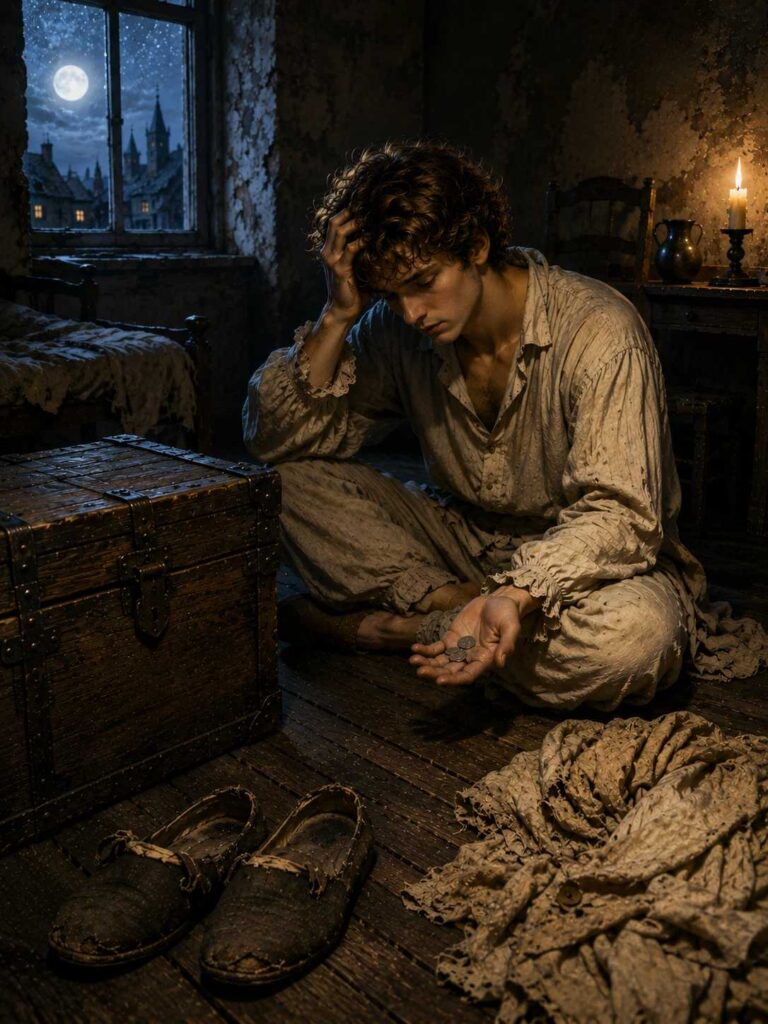
But he had nothing to pack, so he got into the trunk himself.
It was a most remarkable trunk.
As soon as you pressed the lock it could fly.
He shut the lid and pressed the lock, and away flew the trunk up the chimney and into the clouds, higher and higher, with the merchant’s son inside.
Whenever the bottom of the trunk creaked he was terrified, for if the trunk fell to pieces he would have tumbled out, and that would not have been pleasant.

But he got safely to Turkey.
He hid the trunk in the forest under some dry leaves and walked into the town.
He could do this quite well, for in Turkey everyone goes about in dressing-gown and slippers, just as he did.
He met a nurse carrying a little child. “I say, Turkish nurse,” he called out, “what is that great castle near the town, with the windows so high up?”
“The king’s daughter lives there,” said the nurse. “It has been foretold that she will be made very unhappy by a lover, and so no one is allowed to visit her unless the king and queen are present.”
“Thank you,” said the merchant’s son.
He went back to the forest,
got into the trunk,
flew up to the roof of the castle,
and crept through the window into the princess’s room.
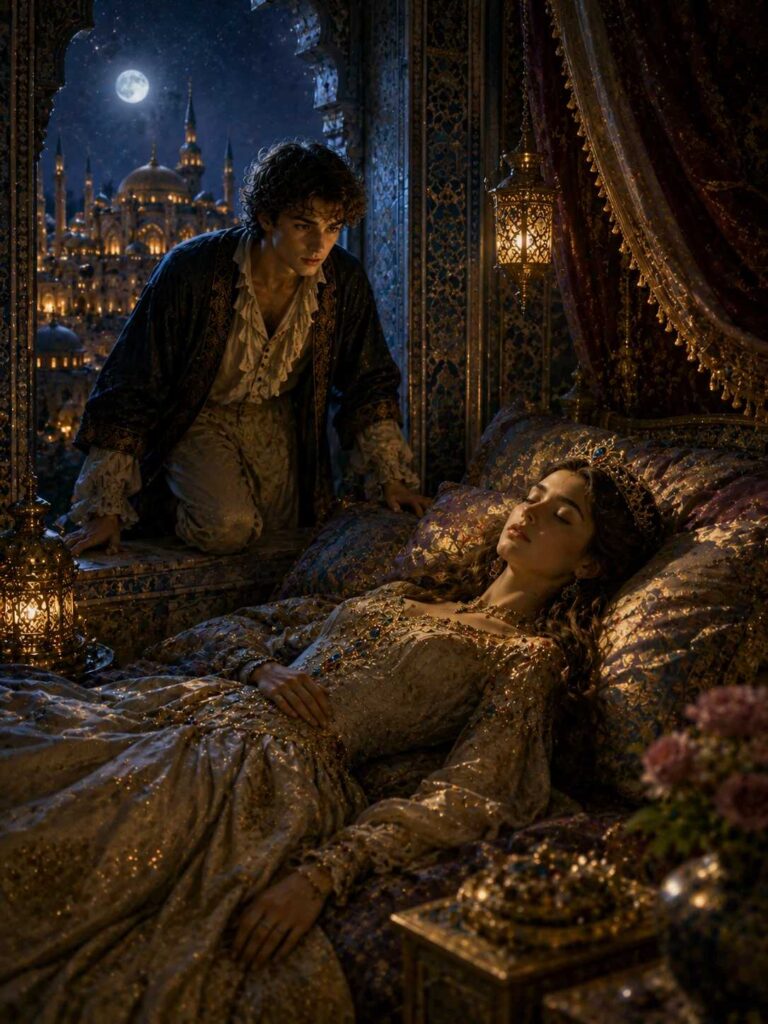
She was lying asleep on the sofa, and she was so beautiful that the merchant’s son could not help kissing her.
She woke up and was very frightened.
But the merchant’s son told her he was a Turkish angel who had come down through the air to visit her, and she was very pleased with that. They sat side by side, and he told her stories.
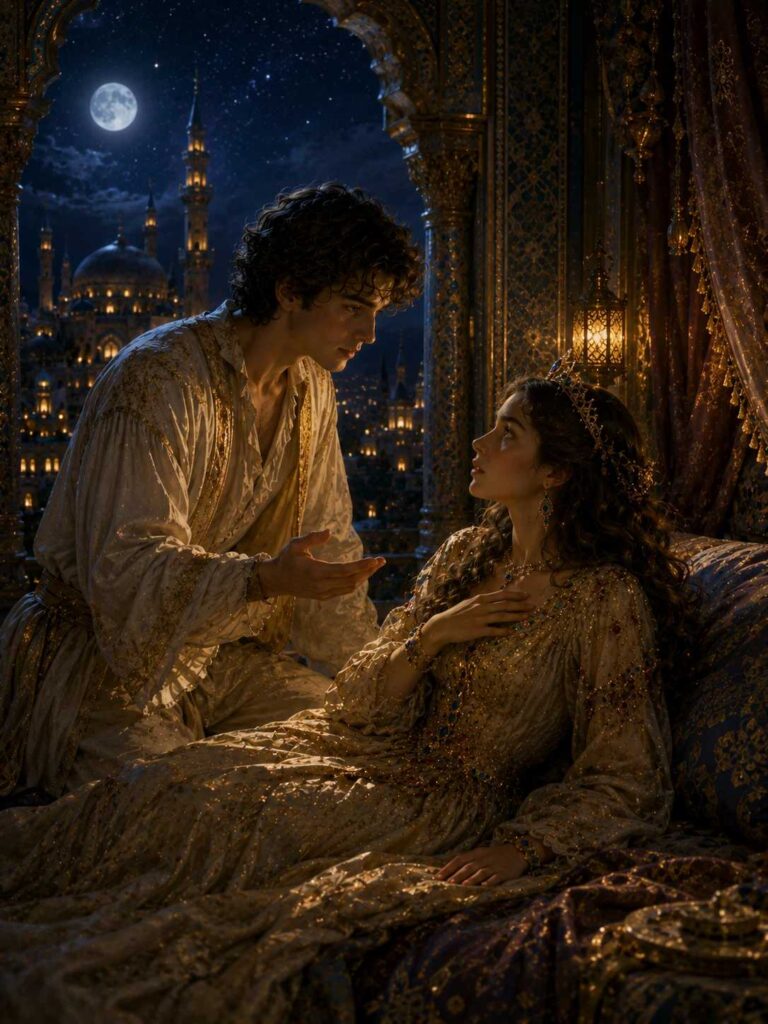
He told her that her eyes were like two beautiful dark lakes where thoughts swam about like mermaids, and he said her forehead was a snowy mountain with the most splendid halls and pictures inside.
And he told her about the stork who brings the beautiful little children from the rivers.
All these were delightful stories. Then he asked the princess to marry him, and she said yes at once.
“But you must come on Saturday,” said the princess, “for the king and queen are coming to tea with me then. They will be very proud that I am going to marry a Turkish angel.
But you must have a very fine story ready, for my parents are very fond of stories. My mother likes them to be moral and high-toned, and my father likes them to be merry and something to laugh at.”
“Very well,” he replied, “I shall bring no other wedding gift but a story.”
So they parted.
But the princess gave him a sword studded with gold coins, which he found very useful.
He flew away to town, bought a new dressing-gown, and then went back to the forest to make up his story. It was not easy, and he had to work hard to get it ready by Saturday.
By Saturday, however, the story was finished.
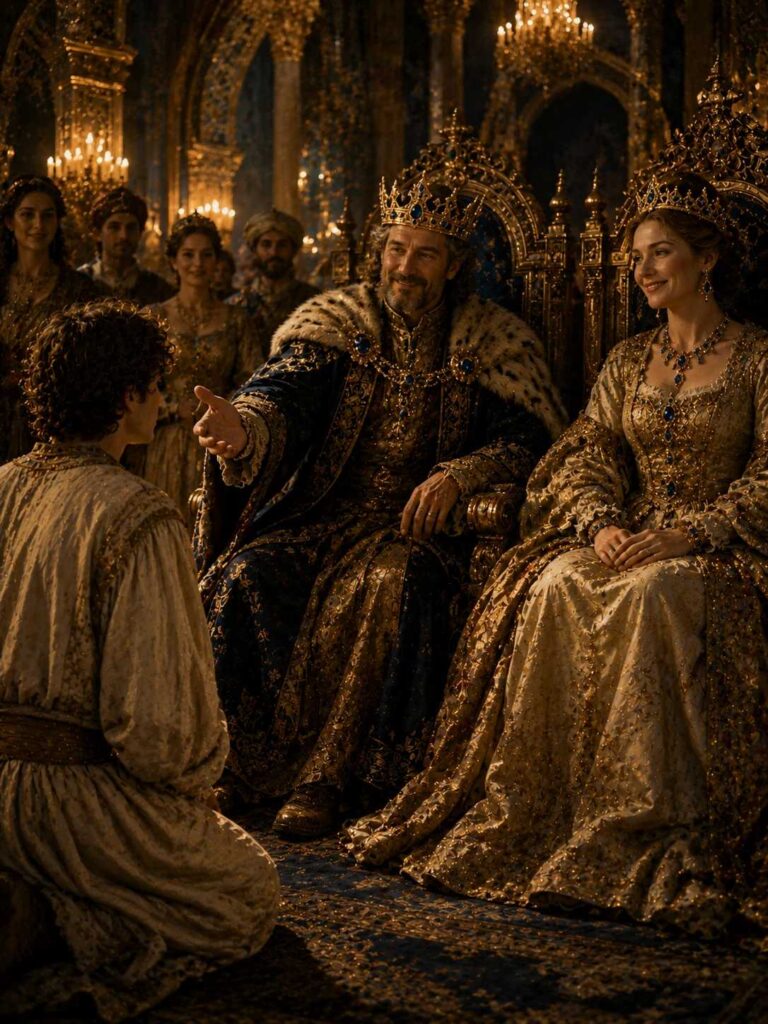
The king and queen and all the court were at tea with the princess. He was received with great ceremony.
“Will you tell us a story?” said the queen. “One that is deep and instructive.”
“Yes, but something to laugh at too,” said the king.
“Certainly,” said the merchant’s son, and he began his story. Now listen carefully.
“There was once a bundle of matches who were exceedingly proud of their high birth. Their family tree, that is to say the great pine tree from which they had been cut, had been a great old tree in the forest.
The matches now lay between a tinder-box and an old iron pot, and they told the story of their youth.
‘Ah, those were the days!’ they said. ‘We grew on the green boughs, as green as they were.
Every morning and evening we drank diamond dew.
When the sun shone, we felt its warmth, and the little birds told us stories.
We were rich too. The other trees only dressed in green in summer, but our family wore green all the year round.
But then the woodcutters came. It was like a great revolution. Our family was felled to the ground.
The head of the family was given a place as mainmast in a fine ship and sailed round the world as much as he pleased.
The other branches were sent to different places, and our task now is to kindle light for common people.
That is how people of quality come to be in a kitchen.’”
“‘My history is quite different,’ said the iron pot next to the matches. ‘From the very first moment I came into the world I have been used to cooking and scrubbing.
I am the first in the house for anything solid and useful.
My only pleasure is to be well scoured after dinner and to stand in my place and have a sensible conversation with my neighbors.
Except for the water bucket, which is sometimes carried into the yard, we all live here together.
We get our news from the shopping basket, who tells us things about the people and the government that are very disturbing.
Yes, one day an old pot was so upset by what it heard that it fell down and smashed to pieces.
I can tell you, that pot was a liberal.’”
“‘You talk too much,’ said the tinder-box, and the steel struck the flint so that sparks flew. ‘Can we not have a merry evening?’”
“‘Yes, let us talk about those who are of the highest birth,’ said the matches.”
“‘No, I don’t like talking about myself all the time,’ said the iron pot. ‘Let us think of some amusement for the evening.
I will begin. I will tell of something that everyone has experienced.
That is easy and interesting. On the shores of the Baltic Sea, near the coast of Denmark —’”
“‘What a beautiful beginning!’ said all the plates. ‘We are sure to like this story.’”
“‘Yes. When I was young I lived in a quiet family where the furniture was polished, the floors scrubbed, and clean curtains put up every fortnight.’”
“‘How interesting the way you tell a story,’ said the broom. ‘One can tell immediately you have been a great deal among women. There is something so pure about it.’”
“‘That is true,’ said the water bucket, and gave a little jump of delight, splashing some water on the floor.”
“The plates rattled with pleasure, and the broom took some green parsley from the dustbin and crowned the iron pot, knowing that it would annoy the others. ‘If I crown him today,’ it thought, ‘he will crown me tomorrow.’”
“‘Now let us dance,’ said the tongs, and began to dance. My goodness, how he kicked one leg in the air! The old cushion in the corner burst out laughing.”
“‘May I have a wreath too?’ asked the tongs, and a wreath was given.”
“‘After all, they are only common folk,’ thought the matches. The tea urn was now asked to sing, but she said she had a cold and could not sing without steam. She was really too proud to sing in the kitchen and would only perform in the drawing room when great people were present.”
“An old quill pen sat on the window ledge, the kind the maidservant used for writing. There was nothing remarkable about it except that it had been dipped too deep in the ink, but it was very proud of that.”
“‘If the tea urn will not sing,’ said the pen, ‘let her alone. There is a nightingale in the cage outside who can sing. She has not had much education, but we need not talk about that this evening.’”
“‘I think it is most unsuitable,’ said the kettle, who was the kitchen singer and half-brother to the tea urn, ‘to listen to a foreign bird. Is it patriotic? Let the shopping basket decide.’”
“‘I am really very annoyed,’ said the basket. ‘More annoyed than any of you can imagine. Is this really how we are spending the evening? Would it not be much better to put the house in order? Let everyone stay in their own place and I will take charge of the whole affair.’”
“‘Let us act a play!’ they all said. At that moment the maidservant came in. They all fell silent and kept perfectly still. Yet there was not a single pot among them who did not think what he could do and how distinguished he was.”
“‘Yes, if we had wanted to,’ they each thought, ‘we could have had a very merry evening indeed.’”
“The maidservant took the matches and struck them. Heavens, how they spluttered and blazed!”
“‘Now everyone can see that we come first,’ thought the matches. ‘How we blaze! How bright we are!’ But before the thought was finished, they were out.”
“What a delightful story!” said the queen. “I feel as if I were really in the kitchen. Yes, you shall have our daughter.”
“Certainly,” said the king. “You shall have our daughter.” The king said “you” to the merchant’s son, for he was now to be one of the family.
The wedding day was fixed, and the whole town was lit up the evening before.
Cakes and buns were thrown among the crowd.
The boys in the street stood on tiptoe shouting “Hurrah!” and whistling through their fingers.
It was all very splendid.
“I must do something to make them happy too,” said the merchant’s son.
So he bought rockets and crackers and every sort of firework he could think of, packed them all in his trunk, and flew up into the air.
Up they went, swishing and whizzing,
bang! bang!

The Turks, seeing such a sight in the sky,
jumped so high that their slippers flew about their ears.
After that it was easy to believe that a Turkish angel was going to marry the princess.
As soon as the merchant’s son came down in his trunk into the forest again, he thought: “I will go back to town and hear what people are saying about me.”
It was very natural that he should want to know.
And what strange things people were saying!
Everyone he asked had a different story to tell, but they all agreed it had been a magnificent sight.
“I saw the Turkish angel himself,” said one man. “His eyes were like shining stars and his head was like foaming water.”
“He flew in a coat of fire,” said another, “and the most beautiful little cherubs were peeping from under the folds.”
He heard many fine things about himself, and that the next day was to be his wedding day.
Then he went back to the forest to get into his trunk again.
But where was the trunk? It was burned. A spark from the fireworks had set it alight and it was in ashes.
The merchant’s son could fly no more and could never reach his bride.

She stood on the roof of the castle all day waiting for him, and she is waiting there still, most likely.
And the merchant’s son wandered about the world telling stories, but they were never again as good as the one he had told about the matches.
Before You Leave
Reflection
Some people
once flew very high.
High enough to see castles above the clouds,
high enough to meet the one meant for them.
But sometimes
what is lost is not the dream.
It is the trunk
that carried you there.
Some stories
are meant to be read
And some stories
are meant to be treasured for a lifetime
If this story
stays with you
If a single line
that stays with you
If you wish
walk with it
a little further