

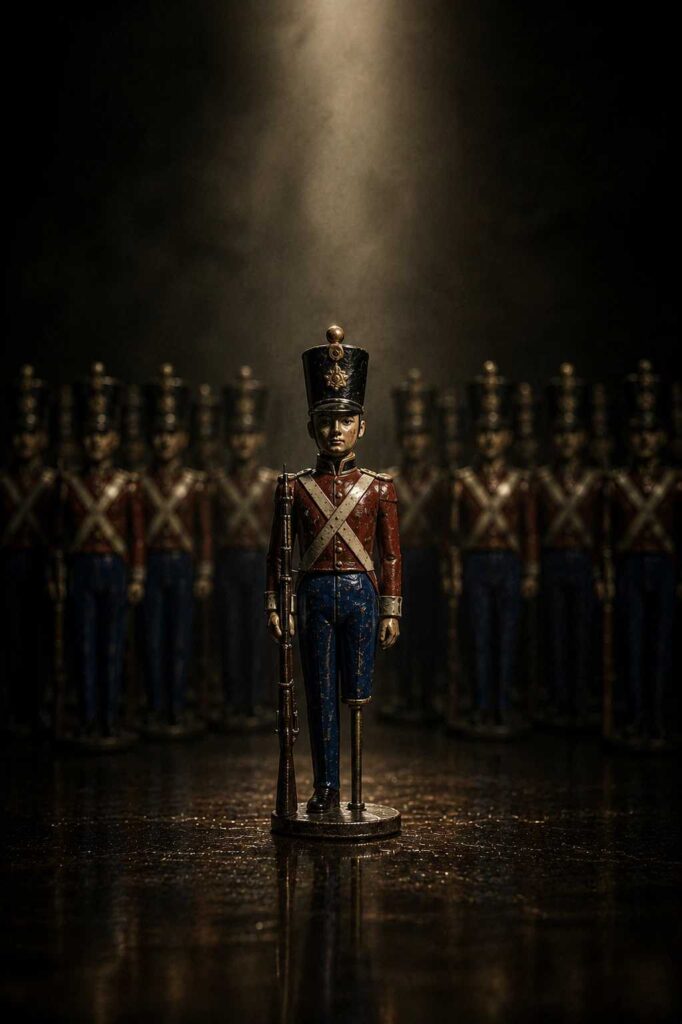
There were once five-and-twenty tin soldiers, all brothers, for they had been made from the same old tin spoon. They shouldered their muskets and looked straight ahead, splendid in their red and blue uniforms. The very first words they heard in this world were “Tin soldiers!” cried by a little boy when their box was opened.
He clapped his hands with delight, for they were his birthday present. He set them all out on the table. Every soldier was exactly alike except one. He had only one leg, for he had been cast last and there was not quite enough tin to finish him. Yet there he stood, just as steady on his one leg, and that made him all the more remarkable.
The table where the tin soldiers stood was covered with other toys, and the most striking of all was a lovely paper castle.
Through the tiny windows you could see right into the rooms. In front of the castle stood little trees around a mirror that was meant to be a lake. Wax swans glided upon it and were reflected in the glass.
All of this was charming, but the most charming thing of all was a little lady standing in the open doorway of the castle.
She too was cut from paper. She wore a skirt of the finest gauze and a narrow blue ribbon across her shoulder like a scarf. In the middle of the ribbon was a glittering gold rose as big as her face.
The little lady was a dancer. She stretched out both her arms, and raised one leg so high that the tin soldier could not see it at all, and thought she had only one leg like himself. “She would be just the wife for me,” he thought, “but she is too grand. She lives in a castle while I have only a box with four-and-twenty others — that is no place for her.
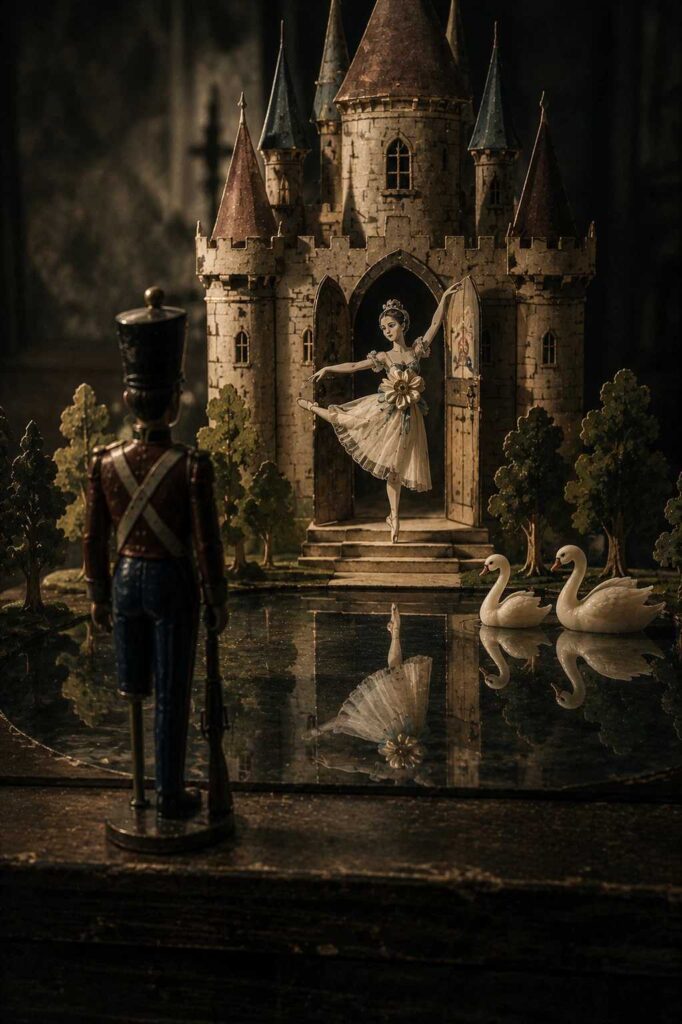
Still, I must make her acquaintance.” So he lay down at full length behind a snuff-box on the table and watched the graceful little lady, who kept standing on one leg without losing her balance.
When evening came, all the other tin soldiers were put away in their box and the people of the house went to bed.
Then the toys began to play — visiting, fighting, dancing. The tin soldiers rattled in their box, for they wanted to join in, but could not lift the lid.
The nutcracker played leapfrog and the pencil pranced about on the table. The racket woke the canary, who began to speak — in verse, no less. Only the tin soldier and the dancer stayed perfectly still. She stood on the tips of her toes with both legs outstretched, as steady as he was on his one.
The tin soldier never took his eyes off her. The clock struck twelve — crack! — up flew the lid of the snuff-box.
Out jumped a little black goblin. There was no snuff inside — it was a trick box.
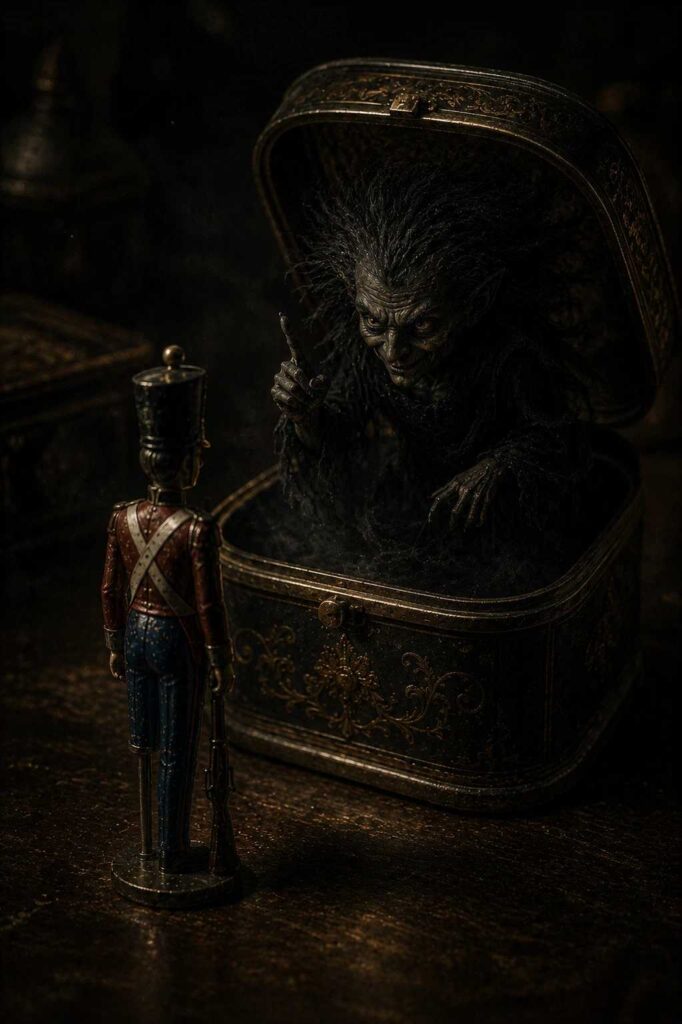
“Tin soldier,” said the goblin, “keep your eyes to yourself.” The tin soldier pretended not to hear.
“Very well, wait till tomorrow,” said the goblin.
When morning came and the children were up, the tin soldier was placed on the window sill.
Whether it was the goblin’s doing or a sudden draught, the window flew open and out fell the tin soldier headlong from the third storey. It was a terrible fall.
He landed head first with his leg sticking up in the air, his helmet and bayonet wedged between the paving stones. The maidservant and the little boy ran down to look for him, but though they nearly trod on him they could not find him.
If only he had called out “Here I am!” they would have found him at once. But he was in uniform and thought it beneath his dignity to cry for help.
It began to rain, falling faster and faster until it was a real downpour.
When it was over, two street boys came by.
“Look,” said one, “a tin soldier. Let’s send him sailing.”
They made a boat out of newspaper, set the tin soldier in it and sent him sailing down the gutter, while they ran alongside clapping their hands.
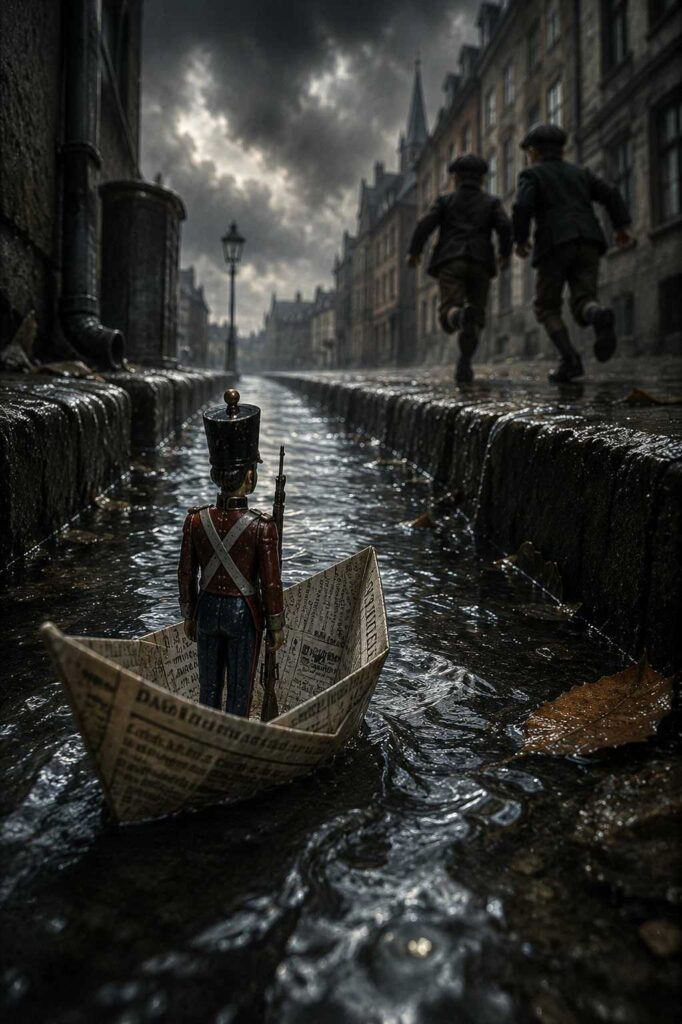
Heavens, what waves there were in that gutter!
What a current!
The rain had been heavy indeed. The paper boat tossed up and down, spinning round and round, till the tin soldier trembled. But he stood firm, keeping his face steady and his musket shouldered, staring straight ahead.
Suddenly
the boat shot under a long plank bridge.
It was as dark here as inside the tin soldiers’ box.
“Where am I going now?” he wondered.
“This must be the goblin’s doing. Ah, if only the little lady were here with me in the boat, I should not mind the dark at all.”
Just then a large water rat appeared. He lived beneath the bridge.
“Your passport!” said the rat. “Show me your passport at once!”
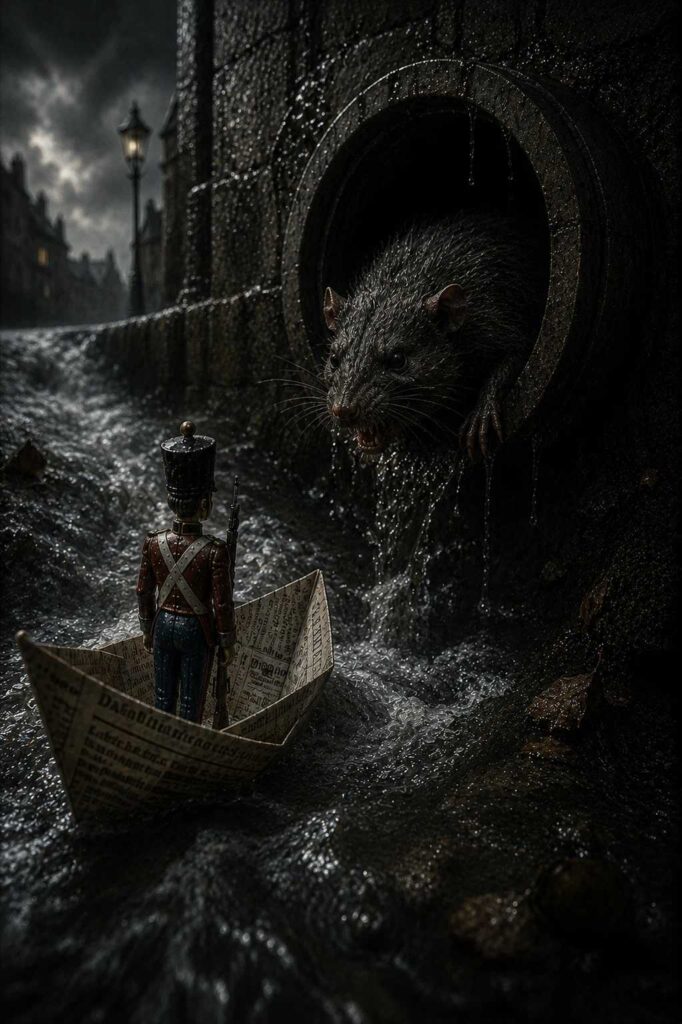
The tin soldier said nothing but gripped his musket tighter than ever.
The boat rushed on and the rat came after it.
He gnashed his teeth and shrieked to the sticks and straws: “Stop him! Stop him! He has not paid his toll! He has shown no passport!”
But the current grew stronger and stronger.
Already the tin soldier could see daylight at the end. Then he heard a roaring that would have frightened the bravest man. The drain poured into a great canal — as dangerous for him as a waterfall would be for us.

He was so close now that he could not stop. The boat shot out. The poor tin soldier held himself as erect as he could and did not blink, to show he was not afraid.
The boat whirled round three or four times, filled with water and was certain to sink.
The tin soldier stood up to his neck in water. The boat sank lower, the paper grew soft and sodden and came apart.
At last the water closed over his head.
He thought of the little dancer whom he would never see again, and the words of an old song rang in his ears:
Farewell, warrior! Ever brave,
drift onward to your grave.
Then the paper fell apart and the tin soldier sank — and was instantly swallowed by a large fish.
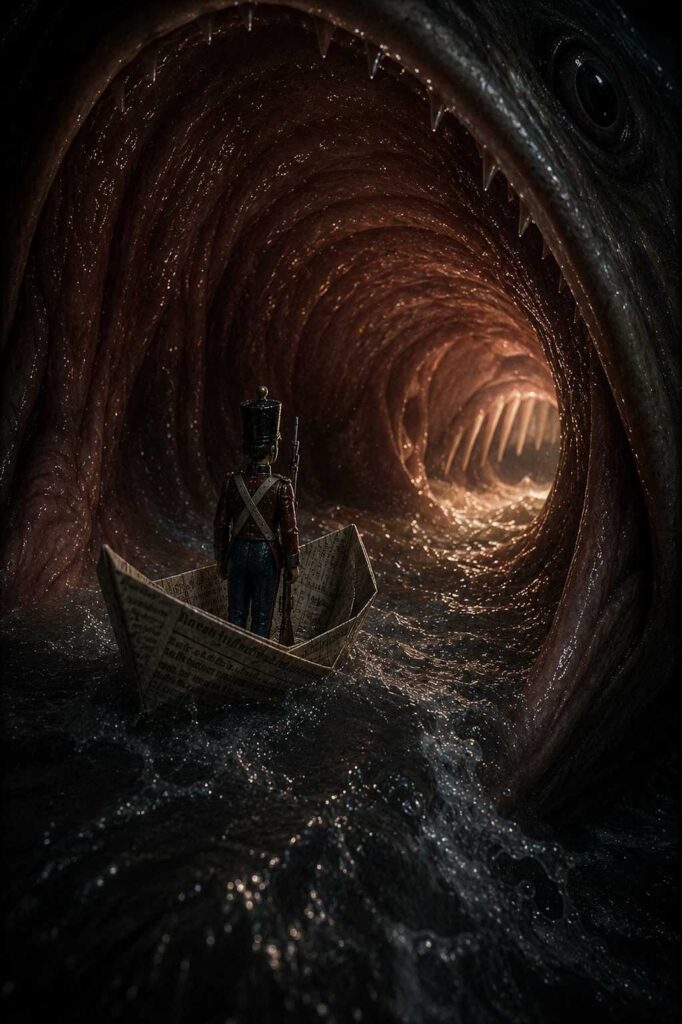
How dark it was inside the fish!
Even darker than under the bridge, and narrower. But the tin soldier was as steadfast as ever, lying with his musket on his shoulder. The fish dived and twisted in the most extraordinary ways, until at last it was quite still.
After a while it was as if a flash of lightning passed through. Daylight streamed in and someone cried: “The tin soldier!” The fish had been caught, taken to market, sold to the cook, who cut it open in the kitchen.
She picked up the tin soldier between her finger and thumb and carried him into the sitting room.
Everyone wanted to see the remarkable soldier who had travelled inside a fish. He was not proud at all. They put him on the table — what strange things happen in this world —
he was in the very same room. There were the same children, the same toys, the same fine castle, and in the doorway — the same graceful little dancer.
She was still balancing on one leg with the other raised high. She was as steadfast as he was.
The tin soldier was so moved he could almost have wept — but soldiers do not weep.
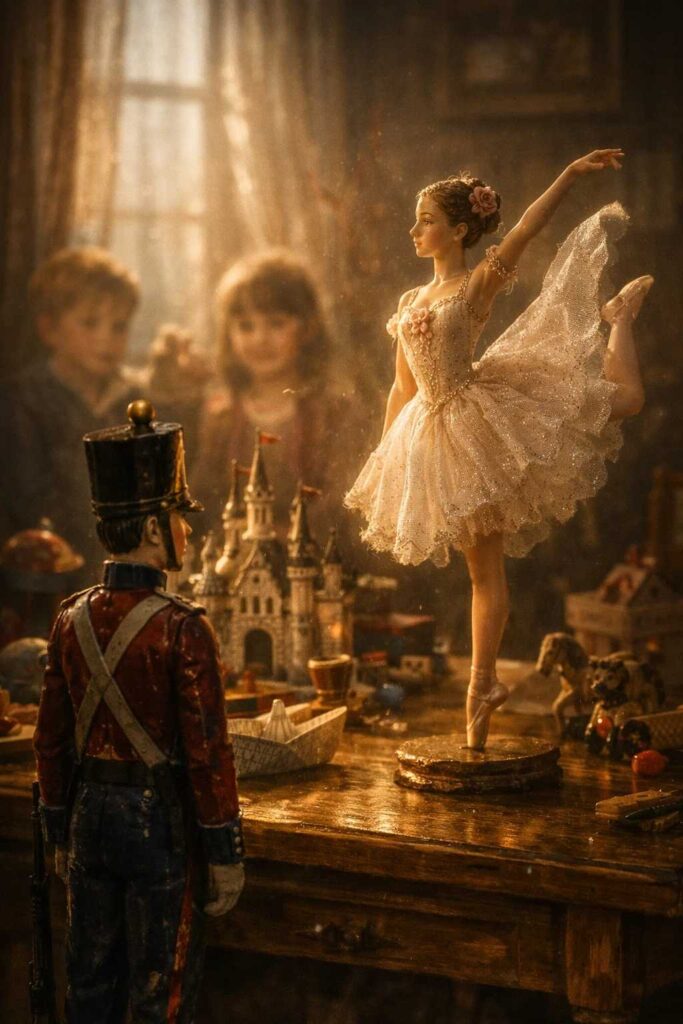
He looked at her. She looked at him. Neither said a word.
Then one of the little boys snatched him up and threw him into the stove. He had no reason for it — it must have been the goblin in the snuff-box.
The tin soldier stood in the flames and felt a terrible heat — from the real fire or from love, he could not tell. His bright colours had quite faded, though no one could say whether from the journey or from grief. He gazed at the little dancer, and she gazed at him. He felt himself melting, but he stood firm and shouldered his musket.
Just then the door flew open. A draught caught the little dancer and she flew like a sylph straight into the stove beside the tin soldier, blazed up and was gone.
The tin soldier melted down to a lump.
Next day when the maid raked out the ashes, she found him in the shape of a little tin heart.
As for the little dancer, all that remained was the gold rose — burnt as black as a cinder.

Before You Leave
Reflection
Some love is never spoken aloud
Some steadfastness
is only revealed at the end of a flame —
when it shows the shape of a heart.
Some stories
are meant to be read
And some stories
are meant to be treasured for a lifetime
If this story
stays with you
If a single line
that stays with you
If you wish
walk with it
a little further