
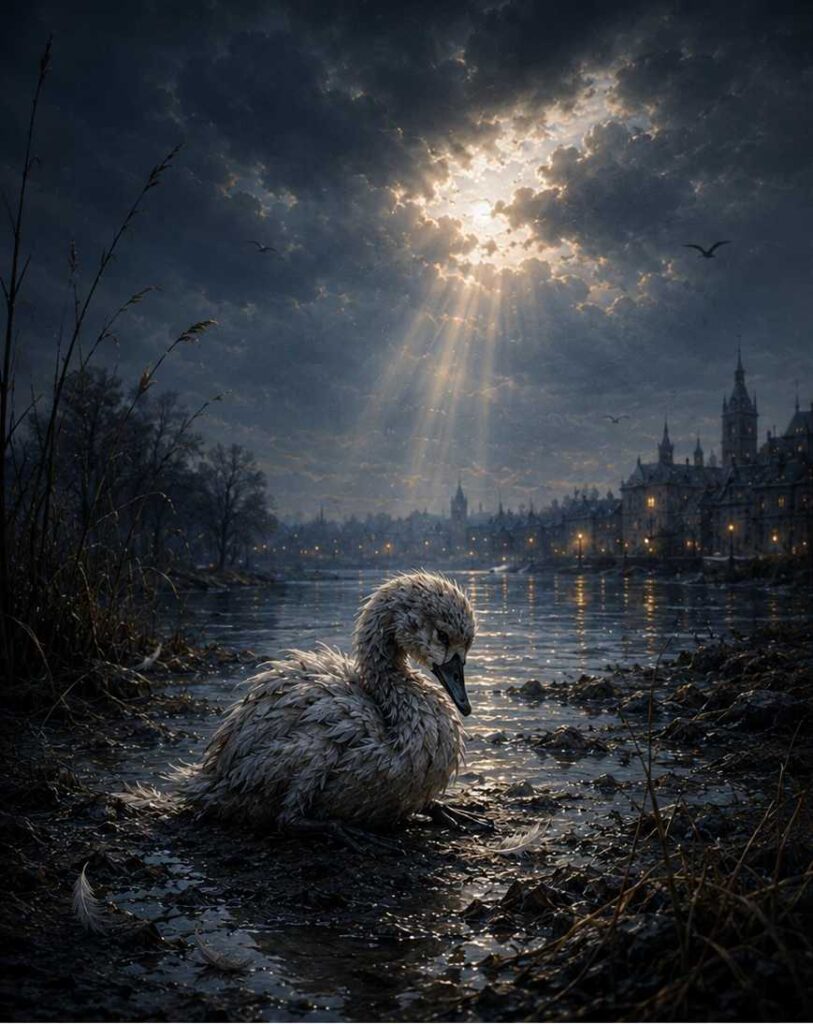
The Ugly Duckling
Hans Christian Andersen
1805 — 1875
“Some solitude,
is simply the path one must walk before learning to fly.”
It was summer. And the countryside was beautiful. The wheat fields shimmered gold beneath the sun, while the oat fields still glowed green. Fresh hay lay gathered across the meadows, and among them wandered the storks on their long red legs, speaking in the strange old language their mothers had taught them long ago in Egypt.
Beyond the fields and open pastures stood a great forest. At its heart lay a deep and quiet lake. Yes — the countryside was wonderfully alive in summer. Near the warmest place beside the water stood an old manor house surrounded by a deep moat. Large dock leaves grew wildly along the stone walls, stretching all the way down to the water’s edge. Some of them were so tall that a small child could disappear beneath them completely. Hidden within those thick green leaves, quiet as the heart of a forest, a mother duck sat waiting in her nest.
Her ducklings were nearly ready to hatch. She had been sitting there for what felt like forever, and she was beginning to grow tired of it. Hatching eggs took time. And hardly anyone came to visit her. The other ducks preferred swimming through the moat instead of waddling through the tall grass to sit beside her and talk.
At last, crack. One egg began to open. Then another. “Peep, peep!” Tiny voices filled the nest as the little ducklings lifted their heads into the world for the first time.
“Quack, quack!” called the mother duck. And immediately, all the ducklings began quacking as loudly as they could, looking around curiously at the great green world surrounding them. Their mother allowed them to stare as much as they wished. Green, after all, was good for the eyes.
“How enormous the world is!” the ducklings cried. Compared to the cramped darkness inside their eggs, everything now seemed impossibly vast.
“You think this is the whole world?” their mother laughed softly. “It stretches far beyond the garden — all the way to the pastor’s fields. Though even I have never wandered that far.” Then she glanced back toward the nest. “Well now... surely all of you are out by this point?” She slowly stood up and looked around. “Oh dear,” she murmured. “Not yet.” One large egg still remained unbroken. “How much longer could it possibly take?” And with a sigh, she settled herself back down onto the nest once more.
Just then, an old duck came waddling over to visit her. “Well,” the old duck asked, “how are things going?”
“This one egg is taking forever,” the mother duck replied. “It simply refuses to hatch.” Then she smiled gently and looked toward the others. “But you really must see these little ones.” “I’ve never seen such lovely ducklings.” “They look exactly like their father…” She paused. “That miserable creature. He hasn’t come to see me even once.”

“Let me see that egg that refuses to hatch,” said the old duck. She leaned closer and narrowed her eyes. “Well now... I suspected as much. It’s probably a turkey egg.” “I made that mistake once myself,” she continued. “And those creatures nearly drove me mad.” “They were terrified of water. No matter how much I called to them or pushed them in, they simply would not swim.” She shook her head dramatically. “Yes... yes. That is definitely a turkey egg.” “You should stop wasting your time on it and focus on teaching the others how to swim.”
The mother duck sighed softly. “I suppose I’ll sit on it a little longer,” she said. “I’ve already spent so much time here. I may as well stay until the midsummer fair arrives.”
“Well, suit yourself,” the old duck replied, before waddling away.
At last— the large egg began to crack. “Peep... peep...” Out stumbled the strangest little duckling anyone had ever seen. He was enormous. And terribly gray. The mother duck stared at him in surprise.
“My goodness,” she murmured. “What a very large duckling.” “He looks nothing like the others.” Then she frowned slightly. “Could he truly be a turkey after all?” But after a moment, she shook her head. “No matter. We shall soon find out.” “He must go into the water — even if I have to push him in myself.”
The next morning, the weather was beautiful. Sunlight fell warmly across the green leaves and quiet water.
The mother duck led all her ducklings down toward the moat. Splash! She jumped straight into the water. “Quack, quack!” she called. And one after another, the ducklings leapt in after her. For a moment the water covered their tiny heads— but quickly they rose again, floating gracefully across the surface. Their little legs paddled naturally beneath them. Every one of them swam beautifully. Even the large gray duckling.
“Well,” the mother duck said with relief, “he certainly isn’t a turkey.” “Just look at the way he swims. And how straight he holds himself.” “He is truly my own duckling after all.” She tilted her head and looked at him again. “And honestly... if one looks carefully enough, he is not entirely ugly.” “Quack, quack! Come along now,” she called. “I shall introduce you properly to the world.” And so she led her ducklings toward the duckyard. “But stay close beside me,” she warned. “And be very careful of the cat.”
The duckyard was loud and crowded. Two ducks were fighting furiously over an eel head,until suddenly the cat snatched it away for herself.
“That,” said the mother duck dryly, “is how the world works.” She smacked her beak softly. Truthfully, she would have liked the eel head herself.
“Now move your legs properly,” she instructed the ducklings. “And mind your manners.” “When you greet the old duck over there, bow your heads politely.” “She is the most important duck here. She has Spanish blood, which is why she is so large.” “And do you see that red ribbon tied around her leg?” “That is a great honor indeed. It means she is highly respected.” The mother duck lowered her voice. “Such distinctions are not given lightly.” “Now then — don’t turn your feet inward when you walk.” “A well-bred duckling carries themselves properly.” “Yes, like that.” “Good. Now bow your heads and say: ‘Quack.’”
The ducklings obeyed exactly as they had been taught. But the other ducks turned to stare at them. “Oh no,” one of them said loudly. “Not another group of ducklings. As though there weren’t enough of us already.” Then her eyes landed on the gray duckling. “Oh dear heavens. That one is dreadful.” “We simply cannot tolerate him.” Without warning, one of the ducks rushed forward and bit the poor duckling on the neck.
“Leave him alone,” the mother duck protested. “He hasn’t harmed anyone.”
“That may be true,” the other duck snapped, “but he is far too ugly. Someone ought to teach him a lesson.”
The old duck with the red ribbon finally spoke. “The other ducklings are quite lovely,” she said. “All except that one.” She glanced coldly toward the gray duckling. “He is clearly not a proper breed.” “What a pity you cannot remake him.”
“That would be impossible, Your Grace,” the mother duck replied politely. “He may not be handsome, but he is an excellent little duck.” “He swims every bit as well as the others.” Then, after a pause, she added gently: “And perhaps... he may grow better looking with time.” “He remained inside the egg rather too long, which may explain his appearance.” As she spoke, she softly brushed the duckling’s neck with her beak. “And besides,” she continued, “he is a drake.” “So beauty matters less.” “I believe he will grow strong.” “And one day, he will find his place in the world.”
The old duck said nothing for a moment. Then finally: “Well enough,” she sighed. “You may all wander about freely now.” “And if any of you happen to find an eel head... bring it to me.”
From that day on, the ducklings settled comfortably into life at the duckyard. All except one. The poor duckling who had hatched last. Because he was so strange-looking, everyone picked on him. They pecked him, shoved him aside, mocked him endlessly. Not only the ducks laughed at him — even the chickens joined in. “What an enormous ugly creature,” they sneered. A pompous turkey cock, born with sharp spurs and convinced he was an emperor, would puff himself up like a ship under full sail and charge directly at the duckling, gobbling furiously until his face turned bright red. The poor duckling had nowhere to go. He did not know what he had done wrong. He only knew that his appearance had made him the laughingstock of the entire yard.
And things grew worse with each passing day. Everyone chased him away. Even his brothers and sisters turned against him. “If only the cat would carry you off,” they hissed. “You ugly thing.” At times, even his own mother would sigh: “I almost wish you would go far away from here.” The ducks bit him. The hens pecked him. Even the servant girl kicked him aside with her foot.
At last, he could bear it no longer. He fled. He flew over the fence so suddenly that the little birds in the bushes burst upward into the sky in fright.
“It is because I am so ugly,” the duckling thought sadly, closing his eyes as he ran. But still, he kept running. Eventually, he reached a great marsh where wild ducks lived among the reeds. Exhausted and heartsick, he stayed there through the night. The next morning, the wild ducks gathered around to inspect the newcomer.
“What sort of creature are you?” they asked. The duckling bowed politely in every direction. “You are remarkably ugly,” the wild ducks told him. “But that hardly matters, so long as you do not marry into our family.” The poor duckling had never dreamed of marrying anyone. All he wanted was permission to rest quietly among the reeds and drink from the marsh water.
He remained there for two days. Then two wild geese arrived. Or rather — two young wild ganders, newly grown and not yet very wise.
“Listen, friend,” they said. “You are terribly ugly.” “And we rather like that.” “Would you care to join us and become a migrating bird?” “Not far from here is another marsh filled with lovely wild geese — young ladies, all graceful and charming.” “With a face like yours,” they laughed, “you may actually stand a chance there.” But suddenly, Bang! Bang! Gunshots exploded across the sky. Both wild geese collapsed lifeless into the reeds, their blood staining the water red. Again Bang! Bang! The entire marsh erupted in panic as flocks of birds burst upward into the air. Bullets rained through the reeds.
A great hunting party surrounded the marsh. Some hunters even sat hidden high among the trees above the water. Blue smoke drifted through the dark forest like storm clouds.
Then came the hunting dogs. They splashed wildly through the marsh, trampling reeds and rushes beneath their heavy paws. The duckling trembled with fear. He buried his head beneath his wings— when suddenly, a huge hunting dog appeared directly before him. Its tongue hung from its mouth. Its eyes burned bright and terrible. The dog leaned close. Opened its jaws wide, revealing sharp white teeth— And then, splash, splash— it walked away. Without touching him.
The duckling let out a shaking breath. “Oh... thank heaven,” he whispered. “I am so ugly that even the dog will not bite me.”
He remained perfectly still, listening to the gunshots echo through the marsh long after the hunters had gone. Only many hours later did he finally dare to lift his head. And then he ran again. Across fields. Across meadows. Against the bitter wind.
By nightfall, he arrived at a tiny, miserable cottage. The cottage was so crooked and broken that it seemed uncertain which direction it intended to collapse. The wind howled fiercely around it. To keep from being blown away, the duckling pressed himself low against the ground. Then he noticed that one hinge on the door had come loose. The door hung crookedly open just enough for him to slip through. And so, quietly, he entered the cottage.
Inside lived an old woman, her cat, and her hen. The cat — whom she called “Sonny” — could arch his back and purr beautifully. If stroked the wrong way, his fur would even spark with static fire. The hen had very short legs, which was why she was called “Shortlegs.” She laid excellent eggs, and the old woman loved her almost like a daughter.
The next morning, the strange little duckling was discovered at once. The cat began to purr loudly. The hen clucked in alarm.
“What is going on here?” the old woman asked, turning toward the sound. Her eyesight was poor, and she mistook the duckling for a large duck that had wandered in from somewhere outside. “Well now,” she said with delight, “this is a fortunate surprise.” “Perhaps I shall finally have duck eggs.” Then she added suspiciously: “Though I certainly hope it is not a drake.”
And so the duckling remained there for three weeks. But no eggs ever appeared. In that cottage, the cat considered himself the master of the house. And the hen believed herself the mistress. Together, they often spoke as though they and the world were one and the same,and that they represented the better half of it.
The duckling sometimes felt there might be more than one way to see the world. But the cat had no patience for such thoughts.
“Can you lay eggs?”she asked.
“No.”
“Then kindly keep your opinions to yourself.”
And the cat said,“Can you arch your back,purr,or give off sparks?” "No"
“No.”
“you should remain silent while intelligent creatures are speaking.”
The poor duckling sat sadly in the corner. Slowly, he began to miss the fresh air. The sunlight. The open sky. And deep within him, an uncontrollable longing began to grow— the longing to float upon the water once again. At last, he could no longer keep the feeling inside.
“What on earth possesses you?”she asked. “You have nothing to do. That is why you get these freaks into your head. Lay some eggs or take to purring,and you will get over it.”
“There is something wonderful about the water,” he said softly. “To drift across it…” “To dive beneath it and feel it close above your head…” The hen stared at him in disbelief. “What strange nonsense has filled your mind?” she snapped. “You have far too much time for foolish thoughts.” “If only you learned to lay eggs or purr properly, you would stop imagining such ridiculous things.” “But it feels so beautiful,” the duckling whispered. “To sink beneath the water…” The hen laughed sharply. “You must be completely mad.” “Ask the cat whether he enjoys diving into ponds.” “He is the cleverest creature I know.” “Or ask our mistress herself.” “There is no one wiser in the world than the old woman.” “Do you imagine she dreams of floating in the water?”
“You do not understand me,”said the duckling.
“Oh? We do not understand you?” the hen replied proudly. “Then who possibly could?” “Surely you do not believe yourself wiser than the cat or the old woman.” “You ought to be grateful.” “You have been given shelter, warmth, and the company of educated creatures.” “And still you complain.” She shook her head. “You are impossible.” “Believe me — I say these things for your own good.” “You should learn to lay eggs.” “Or purr.” “Or make sparks fly.” “Then perhaps your life would finally amount to something.” The duckling lowered his head.
“I think…” he said softly, “I would rather go out into the world.”
“Well then,” said the hen coldly, “go.”
And so he left. Once again, he floated upon the water and dove beneath its surface. But everywhere he went, the other animals turned away from him. For he was still too ugly. Then autumn arrived. The leaves in the forest slowly turned yellow. The wind swept them endlessly through the air. The sky grew heavy and cold, filled with clouds carrying snow and hail. A great black crow sat upon the fence, crying hoarsely into the bitter wind. Even imagining such cold was enough to make one shiver. And for the poor duckling, life became harder than ever.
One evening, just as the winter sun disappeared into the pale white sky, a flock of magnificent birds rose suddenly from the bushes nearby. The duckling had never seen anything so beautiful. Their feathers shone pure and white against the fading light. Their long necks curved gracefully like flowing water. Swans. They cried out with strange and haunting voices as they spread their great wings and flew away from the frozen lands toward warmer skies and open lakes. Higher and higher they soared. And as the duckling watched them disappear into the sky, something deep within him stirred painfully. He turned in circles upon the water, stretching his neck upward after them as though his heart longed to follow. He would never forget those birds. Never forget their beauty. Or the strange feeling they awakened inside him. When they vanished from sight, he dove beneath the water in excitement. And when he rose again, his heart was trembling. He did not know what those birds were. Nor where they were flying. But he felt drawn toward them in a way he had never felt before. And yet he did not envy them. How could he ever imagine becoming something so beautiful? If only the ducks would tolerate him... accept him... that alone would have been enough. Poor duckling. The winter grew colder than ever. To keep the water from freezing around him, he was forced to swim constantly through the night. But with each passing evening, the small circle of open water grew narrower and narrower. At last, the cold became unbearable. Ice closed around him. He kicked desperately to keep the water open— until finally, exhausted beyond strength, he froze in place upon the ice.
At last, the cold became unbearable. Ice closed around him. He kicked desperately to keep the water open— until finally, exhausted beyond strength, he froze in place upon the ice. The next morning, a farmer found him there. The man broke the frozen surface apart with his heavy wooden shoes and carried the duckling home to his wife. Slowly, the duckling awakened. The children wanted to play with him— but he was terrified. He believed they meant to hurt him. In panic, he flapped wildly across the room, crashing into a pan of milk and spilling it everywhere. The woman screamed and threw up her hands. Then the duckling tumbled into the butter churn, then into the flour barrel, before stumbling back out again covered from head to toe. What a sight he must have been. The woman shouted angrily and chased after him with the fireplace tongs. The children laughed and screamed, tripping over one another as they tried to catch him. Fortunately, the door stood open. And at last, the duckling escaped outside into the bushes and newly fallen snow. There he lay quietly, too exhausted to move another step.
And truly, to speak of all the loneliness and suffering the poor duckling endured through that terrible winter would be almost too sorrowful to tell.
But eventually, the sun began to warm the earth once more. The duckling lay hidden among the reeds of the marsh as the skylarks sang above him. Spring had arrived.
Suddenly, he lifted his wings. They felt stronger now. Stronger than they had ever felt before. And before he even understood what was happening, they carried him upward into the air. He flew. Across fields. Across forests. Until at last, he found himself in a beautiful garden. Apple trees bloomed in soft white flowers. The air carried the scent of lilacs. Long branches bent gently toward the shining lake below. Everything around him glowed with the quiet beauty of spring.
And there,upon the water ahead, glided three magnificent white swans. Their feathers moved softly against the lake as though the water itself welcomed them. The duckling recognized them immediately. And suddenly, an old sadness rose inside his heart.
“I will fly to them,” he whispered. “To those beautiful birds.” “They will surely tear me apart for daring to come near them while I remain so ugly.” But after a pause, he lifted his head. “And yet… it does not matter.” “I would rather be killed by them than bitten by ducks, pecked by hens, mocked by the world, or left to suffer through another winter alone.”
And so he flew down onto the water and swam toward the swans. The great birds saw him. They spread their wings and glided toward him across the lake.
“Kill me,” whispered the poor duckling, bowing his head to await his death. But then, he caught sight of his reflection in the clear water beneath him. And what did he see?
No longer a clumsy gray creature. No longer awkward. No longer ugly. He had become a swan. And it did not matter that he had once been born in a duckyard.
For if one is born from a swan’s egg, the world can never truly change what they are. At that moment, all the pain he had endured suddenly seemed worthwhile. For only now could he fully understand the beauty and happiness before him. The great swans circled around him gently, brushing against him with their beaks in welcome.
Soon, children came running into the garden with crumbs of bread and handfuls of grain. “There is a new one!” the youngest child cried happily. “Yes!” the others shouted. “A new swan has come!” They clapped their hands with delight and called for their parents to come see. Again and again, they threw bread into the water, saying: “The new one is the most beautiful of all.” “He is so young… and so graceful.” Even the older swans lowered their heads toward him in greeting.
The young swan felt shy. He hid his head beneath his wings. He did not know what to think. He was happy— yet not proud. For a truly gentle heart can never become arrogant. He remembered how he had once been chased away, mocked, and despised. And now, he heard them say that he was the most beautiful among them all. The lilac branches bent softly above the water. Warm sunlight shimmered across the lake. The young swan lifted his graceful neck toward the sky. And with a heart overflowing with quiet joy, he whispered: “I never dreamed of such happiness when I was still the ugly duckling.”
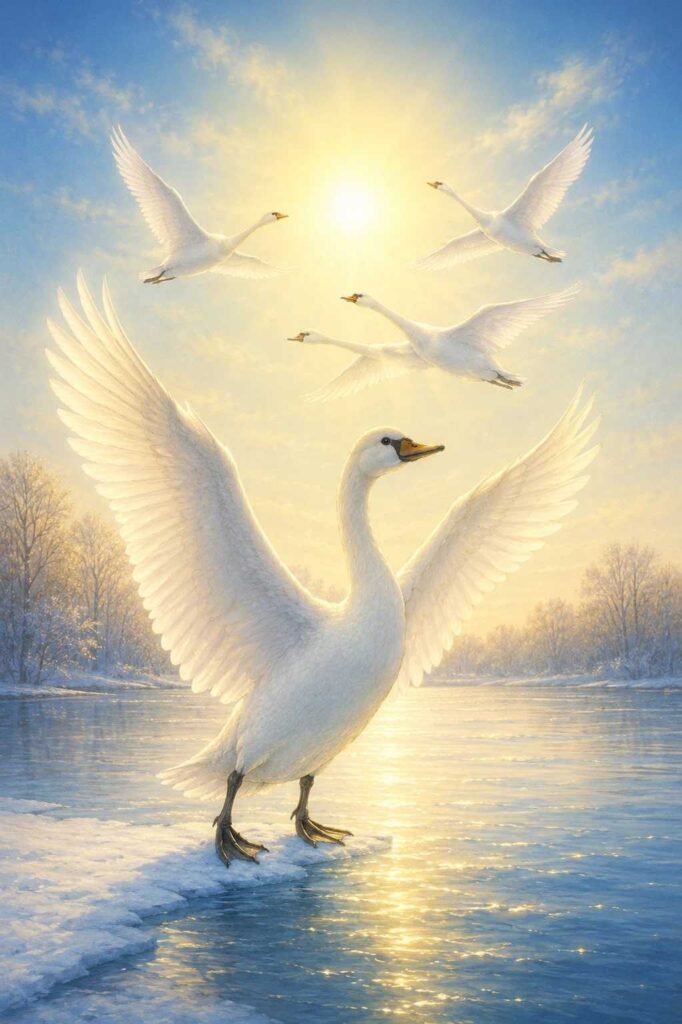
✨ At last, it understood,
it had never truly been an ugly duckling.